How Often to Mow a Sussex County Lawn, and How Short to Cut It
The right mowing schedule follows the grass, not the calendar, and the cutting height matters as much as the frequency.
October 20, 2026 · 4 min read
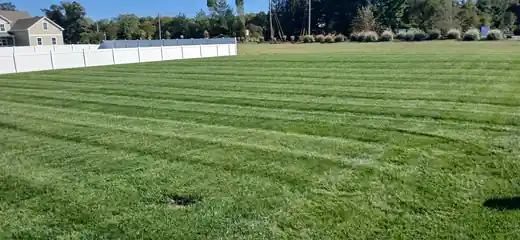
Ask ten homeowners how often a lawn should be mowed and you'll get ten confident answers. The honest one is that it depends on how fast the grass is growing, and that changes with the weather. In and around Millsboro, with sandy, quick-draining soil and humid summers, growth speeds up and slows down more than most people expect. A schedule that works in May can be wrong by July, and a schedule that works for your neighbor's shady backyard can be wrong for your open front lawn.
Mow to the growth, not the calendar
Most lawns do well with a cut every one to two weeks during the growing season. Spring is the fast stretch. Cool, damp weather pushes grass up quickly, and a lawn that looked fine on Monday can look shaggy by the following weekend. Midsummer heat tends to slow many of the cool-season grasses common in this region, so a lawn that needed weekly mowing in May may be perfectly happy on a longer gap in August, as long as it's getting some rain.
Rainfall matters as much as temperature. A wet week followed by sun can add more height than two dry weeks. Sun exposure matters too. The open front yard and the shaded strip beside the garage grow at different speeds, and a good mowing plan accounts for both instead of treating the property as one flat surface. That's the reason a fixed calendar date like "every other Tuesday" sometimes needs adjusting when a stretch of rain hits.
The one-third guideline, and why cutting height matters
The most useful rule in lawn care is also one of the simplest: don't remove more than about one third of the blade height in a single cut. Take a lawn that has grown tall down to short stubble in one pass and you strip away most of the leaf the grass uses to feed itself. The tips turn yellow-brown, the roots pull back, and weeds move into the thin spots.
Height is a choice, not a default. Cutting a little taller, roughly three inches or a bit more for many common lawn grasses, shades the soil, slows moisture loss on sandy ground, and makes it harder for crabgrass and other weeds to get started. The exact number depends on the type of grass, so it's worth knowing what you're growing. Scalping a lawn short for a tidy look is one of the most common ways a good lawn gets thin over a season.
Sharp blades matter as well. A dull blade tears grass instead of slicing it, leaving ragged, frayed tips that turn pale and take longer to heal. If your lawn looks grayish an hour after it's been mowed, a dull blade is a likely suspect. And those stripes you see on a well-kept lawn are just grass bent in alternating directions. They look great, and they're usually a sign that someone is cutting regularly and at a sensible height.
Edging and trimming are not extras
A mowed lawn with untrimmed edges still looks unfinished. String trimming around trees, fences and posts, and cutting a clean line along walks, driveways and beds, is what makes a cut look intentional. Edging also keeps grass from creeping over concrete and into mulch, where it turns into a weeding chore later.
Blowing clippings off hard surfaces is the last step. Clippings left on a driveway get tracked into the house, and clippings left in clumps on the lawn can smother the grass underneath. One customer, Jack A., described what he wanted on the Hertzog Lawn Mowing Service reviews page: "David shows up each week on the day and time he scheduled. He cuts, trims, and blows clippings with care." Showing up when promised and finishing the small details is most of what a mowing service is.
Weekly, bi-weekly or seasonal: picking a plan
Weekly mowing suits fast-growing lawns and properties where appearance matters every week, such as rental homes, HOA common areas and small commercial sites where a shaggy lawn invites complaints. Bi-weekly works for many lawns that are cut a little higher and grow more slowly, especially in the summer heat, though a lawn that gets away from you between visits needs a lighter touch the next time around. Seasonal plans cover spring and summer only, or run through the year with fall cleanups and winter prep added in.
Vacation properties show why flexibility counts. A beach-area second home that sits empty for weeks still grows grass, and nothing signals an empty house like a lawn that's knee-high. At Hertzog Lawn Mowing Service you don't need to be home for a visit, as long as the crew can get into the yard. That works as well for out-of-town owners and landlords as it does for busy families.
If you're not sure which schedule fits your lawn, walk it with someone who can read it. David Hertzog offers free, no-obligation estimates after a walkthrough of your property, there are no contracts, and he serves Millsboro and the surrounding communities in Sussex County. Call (484) 332-5555 to talk through what your yard needs.
Hertzog Lawn Mowing Service, (484) 332-5555
Call (484) 332-5555More articles
Fall Leaf Cleanup in Sussex County: When to Schedule It and Why It Matters
Wait for most of the leaves to come down, but not so long that a wet mat sits on your grass all winter.
Mulch Beds That Hold Their Shape: Edging, Depth, Weeds and Top-Offs
Mulch is the most visible part of a landscape and the easiest to get wrong in small ways that add up.